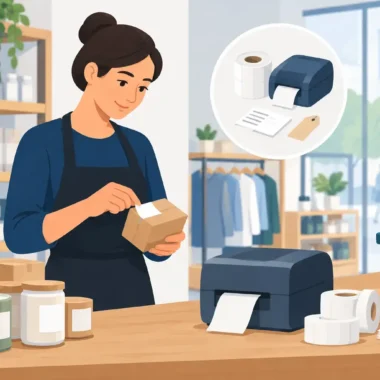
A price label is a small detail until it is missing, unclear or taking too long to apply during a busy trading day. For florists preparing Mother’s Day stock, farm shops rotating fresh lines, or gift retailers building a seasonal display, the choice between manual versus automatic price guns affects more than the speed of one task. It affects how quickly stock reaches the shop floor, how consistently it is priced and how easily staff can keep up when trade picks up.
The right option depends on the number of labels you apply, the information you need to show and who will use the equipment. A simple hand-operated gun remains a sensible choice for many independent businesses. An automatic model can earn its place where volumes are higher, pricing changes frequently or repetitive labelling is holding up the operation.
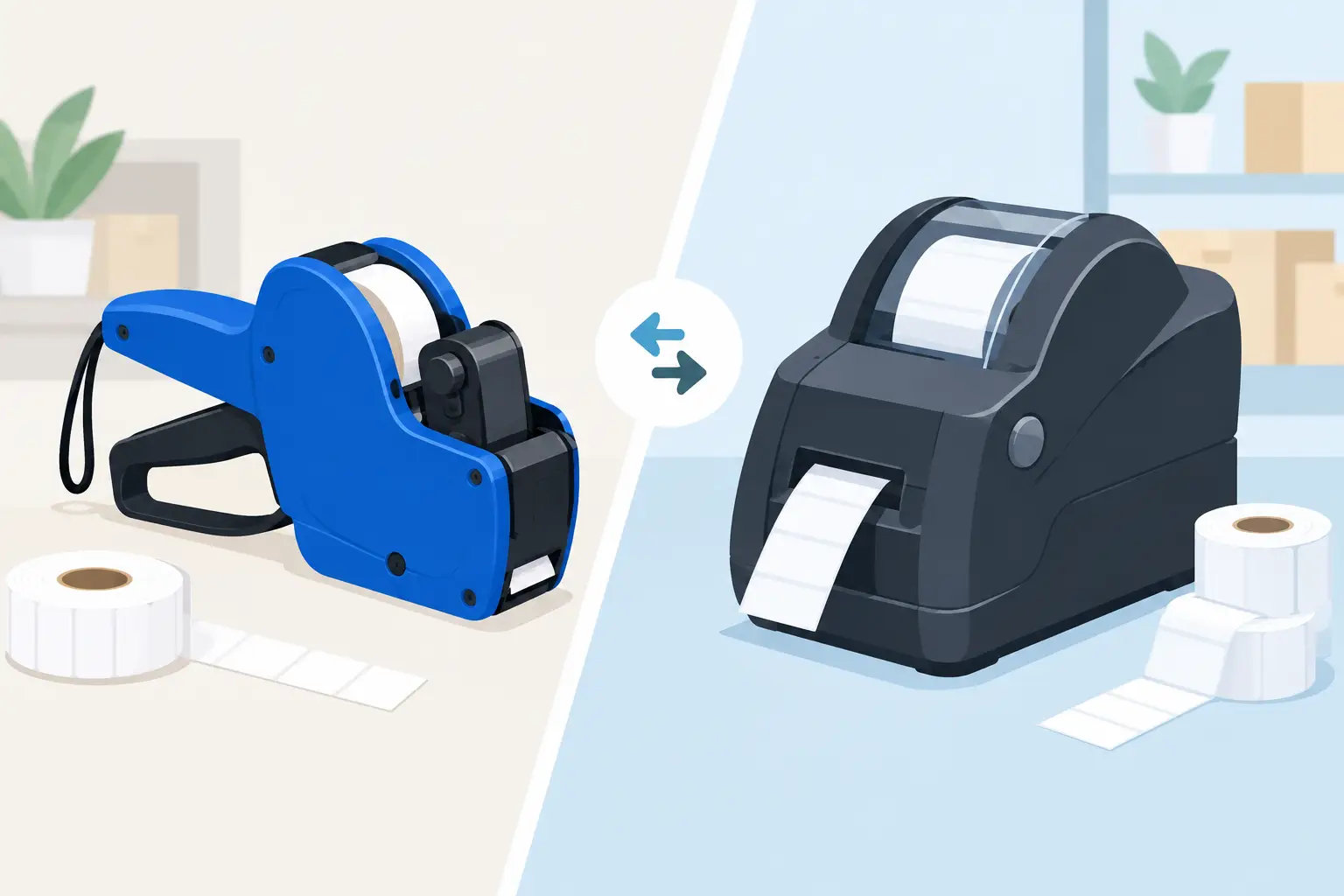
Manual versus automatic price guns: the practical difference
A manual price gun is normally operated by squeezing a trigger. Each pull prints the selected characters onto a self-adhesive label and applies it to the product or packaging. Most are mechanical, using a replaceable ink roller and compatible label rolls. They are familiar, straightforward and well suited to price marking gifts, jars, carrier bags, packaged food, florist sundries and general retail stock.
An automatic price gun uses a powered mechanism to print and dispense labels with less repeated trigger action. Depending on the model, it may be battery-operated, mains-powered or part of a more advanced labelling system. It can be useful for businesses processing larger runs of similarly priced products, especially where staff are applying hundreds of labels in one session.
The wording can be confusing, so it is worth checking product specifications rather than relying on the term “automatic” alone. Some price guns automatically advance the next label after each trigger pull, yet are still manual, hand-operated tools. Others are genuinely powered dispensers. Before ordering, confirm the label size, number of print bands, character set, ink roller type and operating method.
When a manual price gun is the better buy
For many small and medium-sized retailers, a manual gun offers the best balance of cost, reliability and control. It requires no charging point, no software and no complex set-up. Load the correct labels and ink roller, set the price or code, and it is ready for the counter, stockroom or market stall.
This is particularly useful where stock is varied and label quantities are modest. A florist may need to mark a selection of vases, candles, cards and giftware rather than label thousands of identical items. A farm shop may price a small batch of preserves, then switch to seasonal produce or gift packs. In these cases, the few seconds taken to change the setting is rarely a problem.
Manual price guns are also easier to keep as a dependable back-up. If the power is unavailable, a battery needs charging or a more complex label printer develops a fault, a mechanical gun can keep products moving. For businesses with limited counter space or staff who need equipment that can be picked up and used without training, that simplicity has real value.
The trade-off is operator effort. Squeezing a trigger repeatedly throughout a long labelling session can become tiring, and output relies on the user maintaining a steady rhythm. The gun may be perfectly adequate for 50 labels, but less comfortable for 1,500.
Best suited to varied, lower-volume stock
Choose a manual price gun when you price stock in short runs, need a portable tool, or want a practical low-cost solution for general retail use. It is often the right fit for independent shops, market traders, seasonal gift lines and floristry businesses where product ranges change regularly.
A two-line manual gun can be especially useful where the first line carries a price and the second shows a date, batch code or department mark. This gives more flexibility than a basic single-line model without moving into a powered system.
Where automatic price guns save time
Automatic equipment begins to make sense when label application is repetitive enough for speed to matter. If staff are regularly pricing large deliveries, relabelling promotional stock or preparing substantial quantities of packaged goods, reducing the handling time per item can release time for serving customers, merchandising or packing orders.
The benefit is not simply faster printing. A powered process can help staff maintain a more consistent pace over long runs, reducing fatigue and the tendency to rush. This can matter in a busy garden centre, larger farm shop, cash-and-carry environment or retail operation with frequent promotions.
Automatic systems can also be worth considering where label information is more detailed. If labels need product names, barcodes, dates, prices or promotional messages, a conventional price gun may no longer be the most suitable tool. A dedicated label printer and dispenser may provide greater flexibility, even though it costs more and requires more administration.
There are practical costs to weigh up. Powered equipment has more components, may need batteries or mains access, and can require a more specific supply of labels. It is not automatically the best answer simply because a business is busy. If pricing is done in bursts once or twice a week, a quality manual gun may still be more economical and easier to manage.
Best suited to regular, high-volume labelling
An automatic price gun is most useful when the same task is repeated at scale. Think bulk-packed food lines, substantial giftware deliveries, warehouse stock preparation or a retailer applying labels across several branches. The higher initial spend needs to be justified by the labour saved and the improvement in throughput.
Before choosing, consider the busiest week rather than the average week. Christmas, Valentine’s Day, Mother’s Day and local events often reveal whether your existing pricing process is genuinely keeping up.
Labels and consumables matter as much as the gun
A price gun only performs well when it is matched with the correct labels and ink rollers. Labels must be the right dimensions and core size for the model, while the adhesive needs to suit the surface being marked. A label that adheres well to a smooth gift box may behave differently on chilled packaging, textured paper or a bouquet sleeve.
For retail pricing, clear white labels are usually the practical default. Coloured labels can help identify reductions, special offers, departments or dated stock, provided the colour system is simple enough for staff and customers to understand. Avoid using too many variations, particularly in a small shop where pricing needs to be checked quickly.
Ink rollers should be changed when print becomes faint or uneven. Poor print quality causes avoidable queries at the till and can make a professionally presented product look untidy. Keep compatible label rolls and rollers in reserve, particularly before busy seasonal periods. Running out of labels when a delivery is waiting to go onto display is a preventable delay.
Questions to ask before buying
Start with your actual workflow. How many labels do you apply in a normal week, and how many at peak trading times? Are prices usually fixed, or do promotions and reductions mean you are constantly relabelling? Do you need a simple price, or a second line for dates and codes?
Also consider who uses the gun. A tool used by one experienced buyer can be more specialised than equipment shared by counter staff, weekend team members or seasonal employees. In shared-use situations, simple settings, clear loading instructions and readily available consumables are often more valuable than extra features.
Physical product surfaces should also shape the decision. Test labels on the packaging you use most often: cellophane, kraft paper, jars, boxes, food containers, bouquet bags or plastic sleeves. A cleanly printed label that does not stay attached is no use to the customer or the cashier.
Finally, think about continuity. Buying a price gun is not just choosing the unit itself. It is choosing an ongoing supply of compatible labels and ink rollers. Selecting a commonly used format makes replenishment easier and reduces the risk of holding equipment that cannot be used when you need it.
Make the choice around the job, not the feature list
A manual gun is usually the sensible workhorse for varied stock, moderate volumes and straightforward price marking. It is portable, economical and easy to keep in service. An automatic model can be a worthwhile operational investment where high-volume labelling is a regular part of the day, not an occasional rush.
For many trade customers, the most practical approach is to keep a reliable manual price gun available even when other labelling equipment is in use. It provides a quick solution for short runs, late deliveries and unexpected changes on the shop floor. The best pricing equipment is the one that keeps labels clear, stock moving and your team free to focus on customers.