

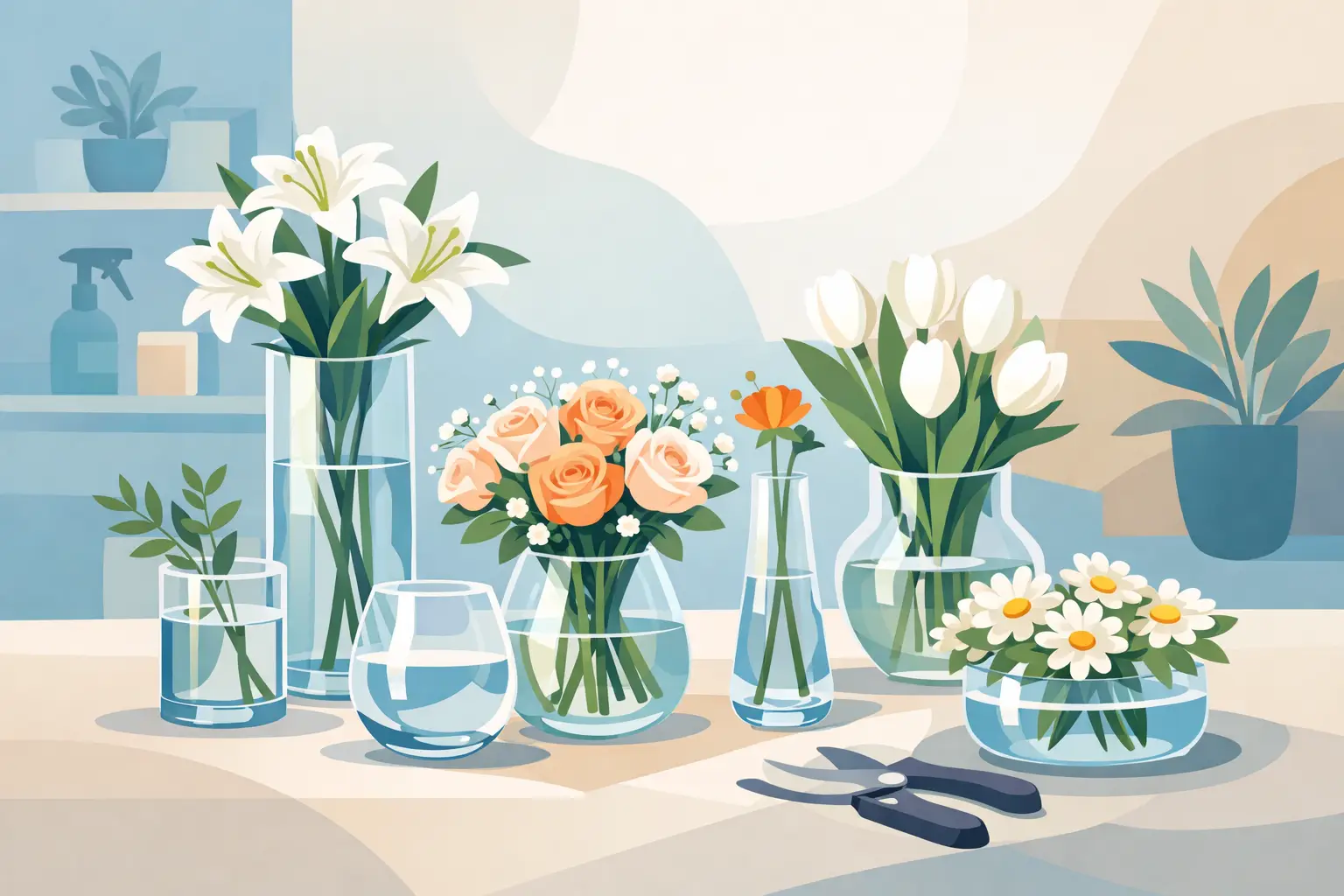
A vase is often the last item chosen for an arrangement, yet it can decide whether flowers look considered on the counter or unstable by lunchtime. For busy shops, glass vases for florists need to do more than look clear and clean. They must support the stem count, suit the occasion, stand up to regular handling and earn their shelf space.
The right core range reduces last-minute substitutions, improves presentation and gives customers a straightforward way to take flowers home ready to display. Buying well starts with the jobs your vases need to do every week, rather than choosing only on appearance.
Start with the arrangements you sell most
A florist who mainly produces hand-tied bouquets needs different vase stock from a business supplying restaurant tables, sympathy work or large event displays. Look at the arrangements leaving your shop over a typical month. Stem length, bouquet width, water requirement and selling price should all influence the vase shapes and sizes you keep on hand.
For everyday bouquets, a medium cylinder or gently tapered vase is usually the practical starting point. It provides enough water for mixed flowers, keeps stems together and works with many colour palettes. A vase that is too wide makes a modest bunch look sparse. One that is too narrow can crush stems or force the arrangement into an unnatural upright shape.
Tall vessels are useful for long-stemmed roses, lilies, delphiniums and branches, but height alone is not enough. The base needs sufficient weight and width to counterbalance the flowers. This matters particularly in retail areas, cafés, pubs and venues where displays may be knocked by customers, staff or passing trays.
Low, wide bowls and fishbowl-style designs suit compact centrepieces, short-stemmed seasonal flowers and floral foam arrangements. They can be highly effective for table work, although their broad opening means mechanics need more attention. Without foliage, chicken wire or suitable foam support, stems can spread apart and leave visible gaps.
Choosing glass vases for florists by shape
Shape affects both the florist’s working time and the finished result. A carefully selected selection of practical shapes will generally serve trade customers better than a large number of unusual vessels that only suit one brief.
Cylinders for dependable everyday use
Straight-sided cylinders are a solid workhorse for retail bouquets and venue flowers. They are easy to fill, clean and store, and their neutral profile lets the flowers remain the focus. Because the opening and base are broadly similar in diameter, they are particularly useful where arrangements are being made quickly to a familiar recipe.
The trade-off is that a cylinder offers little natural support for a loose hand-tied bouquet. If the neck is too wide for the stem count, additional foliage or internal support may be needed to avoid a flat-looking arrangement.
Tapered and trumpet shapes for bouquet display
A vase that narrows towards the neck gives stems more support and can make an ordinary bunch appear fuller. Tapered shapes are well suited to gift bouquets, roses and mixed seasonal work, especially when the customer wants a vase included as part of the sale.
Check the neck opening before buying in quantity. A very narrow neck can be attractive for a few stems, but it may not accept fuller hand-ties or flowers with larger heads. It also makes cleaning more time-consuming if foliage drops into the water.
Cube and rectangular vases for compact designs
Square glass vases create a neat, contemporary finish for reception desks, gift displays and table centres. Their footprint is efficient on shelves and counters, and they work well with short flowers, foliage and arranged foam designs.
They are less versatile for tall bouquets, where their lower centre of gravity and limited height can make proportions difficult. Keep them for the designs they suit rather than expecting them to replace a general-purpose vase.
Bud vases for add-on sales and small displays
Bud vases are useful for single stems, small posies and grouped table displays. Several matching bud vases can create an effective event arrangement without the cost or visual weight of one large centrepiece. They also provide a simple add-on purchase beside loose flowers, cards and gift packaging.
Their main limitation is capacity. They should be treated as a specialist line for a defined use, not as the answer to customers seeking a ready-to-use vase for a standard bouquet.
Match capacity to stems and water needs
Vase capacity is not simply a question of how much water it holds. The water line should sit comfortably below any foliage, while allowing enough depth for the stems to drink. Flowers such as hydrangeas, roses and large mixed bouquets can place greater demand on water volume than a small display of tulips or narcissi.
When comparing products, consider the internal opening as well as the stated height. Two vases of the same height can perform very differently if one has a narrow neck and the other has a broad mouth. For trade ordering, it is useful to work from a small set of proven dimensions that your team understands, rather than relying on a product photograph alone.
A practical range often includes a compact vase for short gift work, a medium all-rounder for everyday bouquets and a taller, heavier vessel for long stems. Add low containers only where you regularly sell table centres or event designs. This approach keeps purchasing clearer and avoids tying up cash in slow-moving shapes.
Consider weight, thickness and handling
Floristry vases are handled repeatedly. They are filled, emptied, moved across workbenches, transported to displays and carried home by customers. Lightweight glass can be suitable for certain decorative uses, but it may not be the best option for fuller arrangements or high-footfall retail environments.
Look for a stable base, even glass thickness and a finish that sits flat on the counter. A vessel that rocks slightly when empty will only become more troublesome once flowers are added. For event work, where staff may need to position many identical vases quickly, consistent sizing and a dependable base save time on site.
There is also a balance between durability and presentation. Heavier glass tends to feel more substantial and may better support large arrangements, but it increases transport weight and can require more careful packing. If customers commonly take vases away with flowers, consider how easily the chosen size can be protected in a carrier bag, bouquet bag or suitable retail packaging.
Plan for cleaning, storage and replenishment
A vase that looks good when new but is awkward to clean will slow down a busy shop. Smooth internal walls, accessible openings and simple forms are easier to wash between uses. Narrow-necked decorative bottles can have their place, but they are less convenient for repeated rental, event or display work.
Storage also deserves attention. Keep the cartons, dividers or protective packing where possible, especially for seasonal stock and larger quantities. Vases should be stored upright, dry and away from crowded areas where staff may need to reach over them for everyday floristry supplies.
For repeat purchasing, consistency matters. If a particular vase becomes part of your regular bouquet offer or event recipe, record its height, opening, capacity and case quantity. That makes reordering simpler and helps staff produce a consistent finish when demand rises around Valentine’s Day, Mother’s Day, Christmas and local event periods.
Buy a range that supports the whole sale
The vase is only one part of the finished transaction. A customer buying flowers for a gift may also need a card, tissue, ribbon, cellophane, a bouquet bag or a carrier bag. Planning these items together makes it easier to present the sale professionally and keeps the counter moving during busy periods.
For trade customers, buying compatible floristry supplies and retail packaging in one order can reduce procurement time as well as delivery administration. The Baggery Sundries supplies cross-category essentials for businesses that need to arrange, package, display and sell without placing separate orders for every task.
Do not overbuy novelty shapes just because they photograph well. A small, reliable selection of glass vases that fit your usual flowers, display space and selling method will usually deliver better value. Add distinctive pieces where you have a clear seasonal plan, event contract or established customer demand.
Choose vessels your team can use confidently, your customers can carry safely and your flowers can genuinely thrive in. That is what turns a glass vase from a decorative extra into a useful part of everyday floristry.












