A busy Saturday can expose every weak point in farm shop packaging. Salad leaves need protecting, loose bakery goods need serving quickly, chilled items need carrying safely, and customers still expect their purchase to look good when it reaches the car. The right packaging is not an afterthought at the till. It supports faster service, cleaner displays and a more reliable customer experience across every department.
For farm shops, the challenge is variety. A single order may include fresh produce, eggs, preserves, cakes, plants, flowers, gifts and locally sourced food. Each line has different handling needs, but buying separate packaging from several suppliers adds time, delivery costs and the risk of running short. A practical packaging range should cover the everyday essentials while allowing the shop to keep its own character on the shelf.
Start with the Products You Sell Most
The most useful way to plan farm shop packaging is by looking at how goods move through the business: from preparation and display to the counter, the customer’s basket and the journey home. This keeps decisions practical. A bag may be inexpensive, but it is a poor choice if it tears under jars, does not suit a bunch of flowers, or holds up a queue because staff have to double-bag every order.
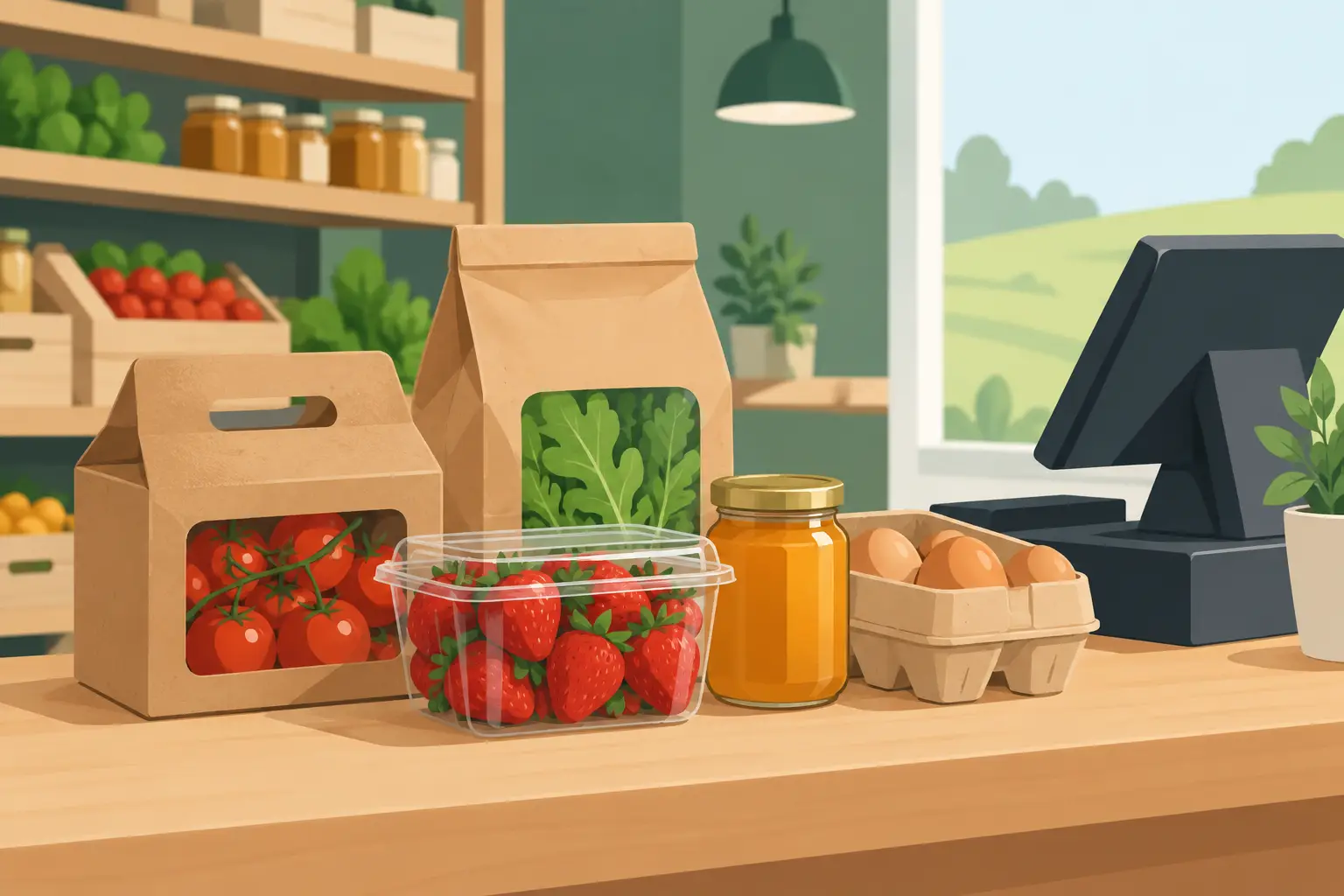
Fresh fruit and vegetables often need a straightforward combination of produce bags, paper bags, punnets, trays or clear film, depending on the item and how it is sold. Loose potatoes, apples and onions need something quick to fill and easy for customers to carry. Softer fruit, tomatoes and delicate salad produce need protection from crushing as well as clear presentation. Where produce is pre-packed, transparent packaging can help shoppers see quality before they buy, while labels provide the product name, weight, price and any information required for sale.
Bakery counters have a different set of priorities. Paper bags, greaseproof sheets, cake boxes and clear bags should suit both the product and the pace of service. A loaf that is still warm, a sticky bun and a decorated celebration cake cannot be treated as the same packing job. Keep the appropriate sizes close to the counter, rather than relying on one oversized bag for everything.
For deli goods, chilled foods and takeaway lines, choose packaging intended for the relevant food-contact use and check the supplier specification before ordering. Consider whether the pack needs to resist moisture or grease, fit a lid securely, or remain presentable after being carried home. Matching containers and lids is a basic detail, but it prevents wasted stock and frustrating delays at the counter.
Farm Shop Packaging for Carrying and Gifting
Carrier bags are one of the most visible parts of a customer’s visit. They need to cope with real farm shop purchases: glass bottles, jars, root vegetables, baked goods and perhaps a bunch of flowers added at the last minute. Paper carrier bags give a natural, traditional look and work particularly well for lighter mixed purchases, bakery goods and gifts. Stronger plastic carrier bags may be more suitable where damp items, heavier loads or wet weather are regular concerns.
There is no single best option. The right carrier bag depends on its intended load, the way customers shop and how the shop wants to present itself. A smaller paper bag may be ideal for preserves and a card, while a larger, stronger carrier bag is a better fit for a weekly produce shop. Keeping a sensible mix of sizes avoids handing out excessive packaging and helps staff pack orders neatly.
Gift sales can be a valuable part of a farm shop’s offer, especially around Christmas, Mother’s Day, Easter and local events. Gift bags, tissue paper, ribbon, baskets, cellophane and clear presentation bags turn a collection of products into a ready-to-give purchase. They also help staff create hampers and seasonal displays without needing to hold a separate range of expensive gift boxes for every occasion.
If your shop sells cut flowers, plants or dried arrangements alongside food and gifts, packaging should work across those departments rather than sit in separate silos. Bouquet bags, cellophane, ribbon and suitable carrier bags make it easier to offer an added-value floral purchase at the till. This is where a broad wholesale range can reduce the number of suppliers your team has to manage.
Make Displays Easier to Shop
Good packaging does more than contain a product. It helps customers identify, compare and choose it. Clear bags can show the contents of cakes, confectionery, dried goods and gift items. Kraft paper, tissue and baskets can give locally made or seasonal lines a considered appearance. The material should suit the product rather than follow a single look across the entire shop.
Labels are just as important. A clear label can carry a product name, price, weight, batch detail or promotional message while helping shelves and counter displays stay organised. For businesses with frequent price changes, a price gun and compatible labels can be quicker and more consistent than handwritten stickers. Shelf-edge tickets, card holders and point-of-sale materials also help customers find offers without needing to ask staff for every price.
Keep presentation practical. Labels must adhere properly in the conditions where they are used, whether that is a chilled cabinet, a paper bag or a smooth clear pack. Packaging that looks smart at the start of the day but curls, smudges or comes loose by lunchtime creates more work and weakens confidence in the display.
Check the Journey from Shelf to Car
Before committing to a bulk order, test packaging with actual stock and normal customer behaviour. Fill the bag or container as it would be used, not as it appears in a catalogue photograph. Check whether it stacks, whether staff can pack it quickly and whether it stays tidy during a short journey.
Four checks are worth making before a busy period:
- Does the packaging fit the product without excessive empty space or crushing?
- Can staff access, fill and seal it quickly at peak times?
- Is it strong enough for the usual weight and shape of the purchase?
- Does it support the required product information and your chosen presentation?
This small amount of testing is especially useful for hampers, mixed produce boxes and seasonal bundles, where a pack has to accommodate items of different shapes and weights.
Buy Enough for Busy Periods Without Overstocking
Packaging is a consumable, so availability matters as much as unit price. A cheaper line is not a saving if the shop runs out before a bank holiday, harvest weekend or Christmas trading period. Review usage by department and order according to how quickly each item moves. Carrier bags, labels, tape, packing paper and standard food packaging usually need deeper stock than occasional gift wrap or specialist seasonal materials.
It is sensible to keep a small contingency supply of core lines, particularly where a substitute would disrupt service. That does not mean tying up cash in every possible size and colour. Standardising on a manageable range of bag sizes, label formats and containers makes storage easier, helps staff work faster and gives purchasing a clearer reorder point.
Bulk buying can offer better wholesale value, but only where there is room to store stock cleanly and dryly. Paper goods can be damaged by damp conditions, clear packaging can be marked if badly stored, and mixed cartons become difficult to manage if there is no labelled storage area. Organise stock so the oldest usable packaging is taken first, and keep matching components, such as trays and lids, together.
For a mixed retail operation, consolidating floristry supplies, packaging, labels, ribbons, carrier bags and point-of-sale essentials into one trade order can save time as well as delivery administration. The Baggery Sundries supplies this kind of cross-category range for businesses that need practical stock on hand rather than a collection of separate purchasing jobs.
Keep Packaging Choices Commercial
The best farm shop packaging earns its place by solving a real operational problem. It may protect a premium product, improve the speed of a counter transaction, make a gift line easier to sell or prevent an awkward customer carry-out. It does not have to be elaborate to be effective.
Review your core lines after the next busy weekend. Ask counter staff which packs slow them down, look at what customers struggle to carry, and note where products arrive at the till without suitable protection. Those details will point you towards a packaging range that works properly when trade is at its busiest.