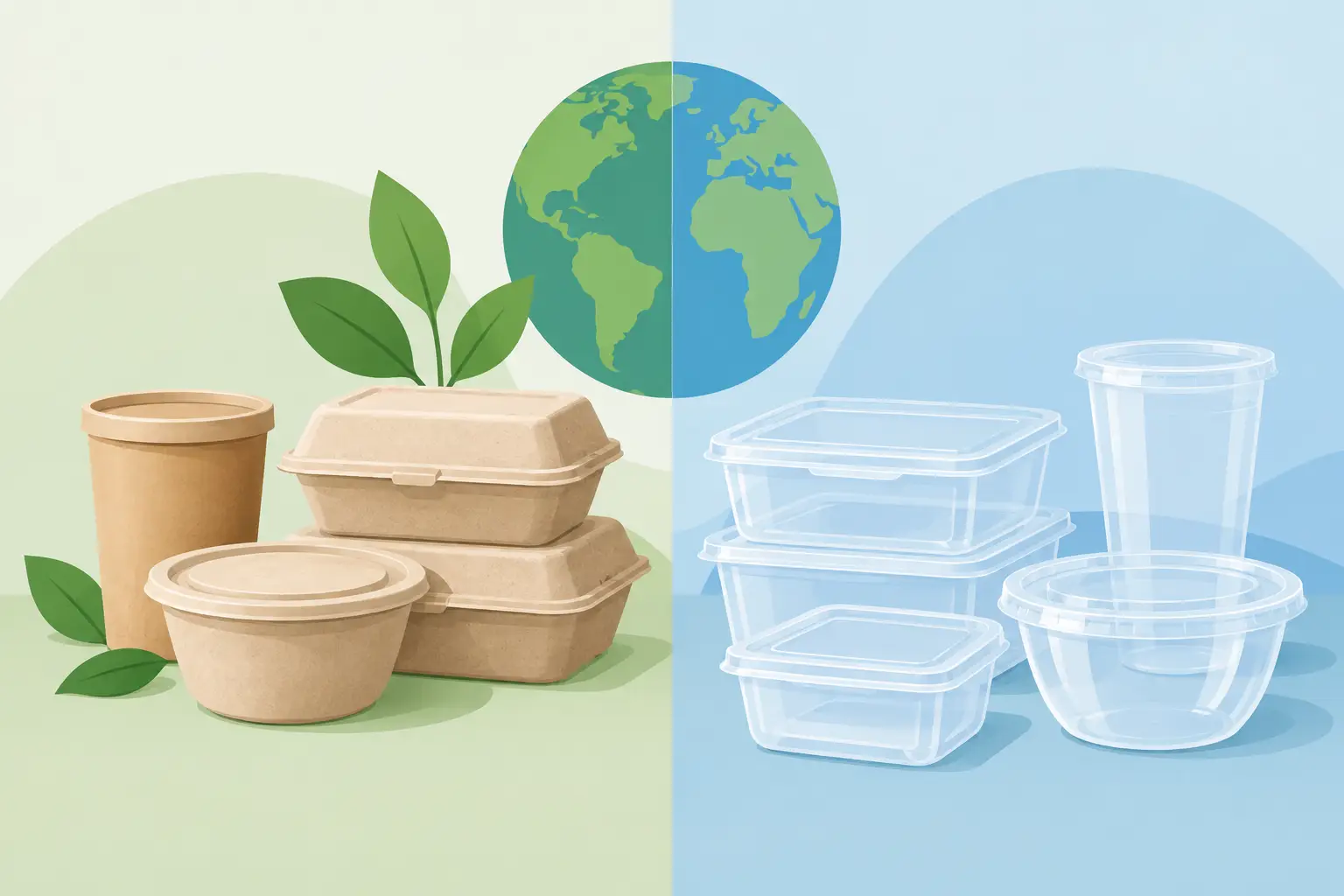
A hot curry that leaks in a customer’s car, a salad box that softens in the fridge, or a container that cannot be disposed of as expected can cost far more than a few pence saved on a case price. When choosing biodegradable versus plastic food containers, UK food businesses need to look beyond the label and assess how each option performs in real service, storage and disposal conditions.
For cafés, farm shops, market traders, caterers, pubs and takeaway operators, the right container protects food quality, supports a professional presentation and keeps packing quick during busy periods. The best choice is rarely based on one factor alone. It depends on the food being packed, how long it will be stored, whether it is reheated, and what waste route is realistically available to the customer.
Biodegradable versus plastic food containers: the practical difference
The term biodegradable is often used broadly, but it does not automatically mean a container will break down quickly in any bin, garden or natural setting. Many plant-based food containers are designed to compost under specific conditions, often in commercial composting facilities. Without the right collection and processing route, they may still end up in general waste.
Plastic containers are equally varied. Clear PET containers are commonly used for cold food, salads and bakery items because they give good visibility and rigidity. Polypropylene containers are often chosen for hot foods because they can cope better with heat and are available in useful formats for takeaway meals, soups and deli counters. Some plastics can be recycled where local collections accept that format, provided they are reasonably clean and separated correctly.
The decision is therefore not simply plant-based versus plastic. It is about material suitability, food safety, customer expectations, disposal arrangements and the total cost of packing each order.
Start with the food, not the packaging claim
A container needs to do its job before it can support any environmental objective. Consider temperature, moisture, fat content and journey time from counter to customer.
Hot, oily or sauce-heavy food places high demands on a container. A moulded fibre or bagasse option may be suitable for some hot meals, particularly where it has a secure fitted lid, but performance can vary by product. Check whether the container is intended for hot, wet foods and whether the lid remains secure during transport. A flimsy lid or a base that absorbs moisture will quickly undermine the customer experience.
Cold foods bring different priorities. A clear plastic salad bowl or hinged container can make fresh ingredients easy to see, stack neatly in a display fridge and protect the product from handling. For a farm shop, deli or food-to-go counter, visibility can directly help sales. A compostable alternative may be appropriate, but check clarity, rigidity and fridge performance before changing a packaging line.
For foods that customers may reheat, confirm the manufacturer’s guidance. Do not assume that a container marked biodegradable is microwave-safe, or that every plastic tub is suitable for reheating. Food-contact suitability, temperature limits and use instructions should be checked for the specific item, lid and intended application.
Disposal is where the environmental result is decided
Compostable and biodegradable packaging can be a sensible choice where a business controls the waste stream. For example, a venue with a suitable commercial collection service may be able to send accepted food-soiled compostable packaging with food waste, subject to the collector’s rules. In that setting, the material choice has a clearer route after use.
For takeaway businesses, the picture is less certain. Customers may put the container in a general waste bin, a recycling bin or a home compost heap. Labelling alone does not guarantee correct disposal. If a compostable item is placed in recycling, it can be treated as contamination. If it goes in general waste, it may not receive the composting conditions it was designed for.
Plastic also requires honest handling. A recyclable plastic container is only likely to be recycled if the local authority accepts that material and it is not heavily contaminated with food. Businesses should avoid making broad environmental claims that customers cannot act on locally. Clear, factual wording such as disposal guidance based on the packaging specification is more useful than a vague green message.
Before committing to a format, ask two straightforward questions: what route does this packaging have once the customer has finished with it, and can we explain that route clearly? If there is no reliable composting collection, a recyclable plastic option that performs well and uses a recognised material may be the more practical choice.
Cost should include more than the unit price
Biodegradable food containers can cost more per unit than standard plastic formats, especially where heavy-duty construction, fitted lids or specialist coatings are required. That does not mean they are poor value. A business may justify the additional spend through its brand position, customer preference, venue waste arrangements or reduced use of separate packaging components.
However, unit cost should be considered alongside breakages, leakage, packing speed and stock management. A cheaper container that needs an additional bag, tape or sleeve to keep it secure is not necessarily cheaper once labour and consumables are included. Likewise, running several near-identical sizes can create avoidable stock complexity for a small kitchen or counter team.
Look at case quantities, storage space and turnover. Bulky containers can occupy valuable back-of-house room, while slower-moving specialist lines can tie up cash. For regular trade purchasing, it is often more efficient to standardise a core range of sizes that covers the majority of dishes, then add a specialist option only where it genuinely improves presentation or performance.
Presentation still matters at the point of sale
Food packaging is part of the product customers take away. A well-fitting lid, clean finish and container proportioned to the portion size can make a prepared meal, slice of cake or deli salad look more considered. Over-sized packaging can make a portion appear poor value, while an overfilled container is difficult to close and more likely to spill.
Plastic containers have an advantage where product visibility is central to the sale. Clear lids can help display colourful salads, pastries, fruit and chilled desserts without repeated handling. Compostable bowls, trays and boxes can suit businesses that want a natural kraft or fibre appearance, particularly for street food, bakery items and casual catering.
Neither look is automatically better. Match the container to the food and the way it is sold. A premium deli counter may need clarity and a tamper-evident seal; a festival caterer may put greater value on stackability, heat handling and straightforward disposal instructions.
Check the specification before placing a bulk order
For trade buyers, a sample or small trial is worthwhile before moving a busy line across to a new material. Test the container with the actual food, at the expected serving temperature and for the usual delivery or collection time. Fill it to normal portion level, fit the lid, stack it, refrigerate it if needed, and check it again after an hour.
The specification should cover dimensions, capacity, material, lid compatibility and food-contact use. Also check whether the container is supplied with lids separately, as this affects both ordering and margin calculations. A container and lid that look similar can still be incompatible across ranges.
Where environmental claims are relevant to your customers, retain product information from the supplier and use only wording that reflects the material’s stated disposal route. This is especially useful for retailers and caterers producing their own shelf tickets, menu notes or packaging messages.
Choosing a workable range for your business
A sensible food packaging range is usually built around the work your team does every day. A sandwich shop may need clear cold-food containers, wrap packaging and carrier bags. A hot-food takeaway may need microwavable tubs, leak-resistant lids and paper bags. A farm shop may need a mixture of produce bags, bakery packaging, deli pots and labels for pricing and traceability.
Buying related items from one dependable wholesale supplier can reduce ordering time and help avoid gaps in essential consumables. The Baggery Sundries supplies food packaging alongside carrier bags, labels, tape and point-of-sale essentials, which can make routine replenishment more straightforward for busy trade customers.
The right choice is the container that arrives in stock, suits the food, survives the journey and has a disposal message you can stand behind. Test it properly, order it consistently, and let practical performance guide the next case you buy.