A hot soup container that leaks in a delivery bag, a salad box that turns soft in the chiller, or a lid that customers cannot separate from the tray will undo the value of any environmental claim. Compostable takeaway packaging trends are therefore moving beyond a simple swap from plastic to paper. For UK food businesses, the priority is packaging that presents food well, handles the journey to the customer and works within the disposal options actually available.
For cafés, farm shops, pubs, market traders and independent food retailers, this is a purchasing decision with practical consequences. Packaging has to suit the menu, the service style and the pace of trade. It also needs to be ordered reliably in sensible quantities, particularly through seasonal peaks when a missed delivery can bring service to a halt.
Compostable takeaway packaging trends: performance first
The strongest trend is more precise specification. Buyers are increasingly asking what a product is made from, what conditions it can tolerate and whether the complete pack is compostable, rather than relying on a broad “eco” label.
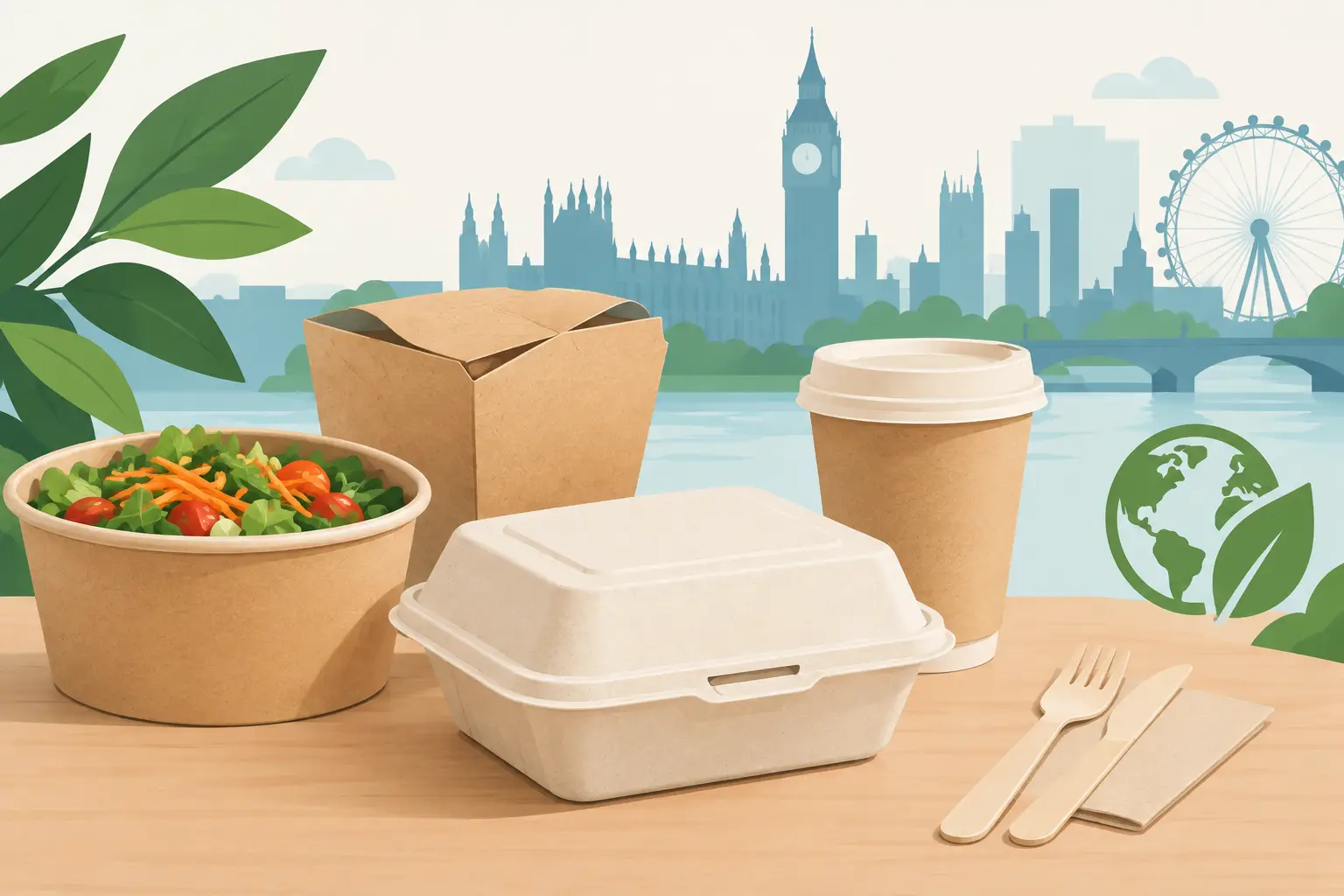
Moulded fibre and bagasse containers remain popular for hot food, particularly for loaded fries, curries, burgers and street-food portions. They offer a natural appearance and good rigidity, but performance varies by design and coating. A shallow tray may be ideal for dry food served immediately, while a saucy meal travelling 20 minutes needs a deeper, more secure format.
Paperboard food boxes are also being selected with the food in mind. Grease resistance, folding strength, ventilation and closure all matter. A box that keeps chips crisp may not be the right choice for a dressed salad, and a heavy bakery item may need a firmer base than a lightweight pastry bag.
The shift is towards matching the material to the job rather than making one packaging line cover every dish. That may mean retaining separate formats for hot, chilled, greasy and dry foods. It can add a little complexity to stock control, but it reduces complaints, waste and replacement costs.
Fibre-led packaging is becoming the default look
Natural kraft paper, moulded fibre and bagasse have become familiar to customers. For many independent businesses, this has made fibre-led packs a practical choice for counters, takeaway service and food-to-go displays. The appearance is straightforward, suitable for a farm shop, deli, café or market stall, and can sit comfortably alongside paper carrier bags, napkins and labels.
However, a natural finish is not proof of compostability. Some paper products have barrier layers or treatments that affect how they should be disposed of. The same applies to windows, labels and lids. Buyers should check the specification for the exact item rather than assuming that a brown or unbleached appearance tells the whole story.
For branded food businesses, print requirements also influence the decision. A plain stock pack with a branded sticker can be more flexible than committing to printed cartons, especially where menus change often or quantities are modest. It gives a professional finish without leaving expensive obsolete stock when a promotion or menu line ends.
Clear lids remain a practical compromise
Customers like to see cakes, salads, sandwiches and chilled deli food before buying. That keeps clear lids and windows in demand, even where the main container is fibre-based. The trade-off is that mixed-material packs can be harder to explain and sort after use.
Where product visibility is essential, keep the format simple. Use a lid designed for the matching base, avoid unnecessary extra inserts and make sure staff know which components go together. A secure fit is just as important as the material claim: lids that pop off in transit create food waste, refunds and a poor impression of the business.
Compostable does not always mean home compostable
One of the most useful changes in trade buying is greater awareness of composting conditions. A product described as compostable may require commercial composting facilities, where heat, moisture and processing are controlled. That is different from a home compost heap, and different again from what a local authority accepts in its food and garden waste collection.
This matters because collection arrangements are not consistent across the UK. A pack can be certified for industrial composting yet still be unsuitable for a customer’s household bin if the local service does not accept it. Clear disposal wording helps, but it should be accurate and proportionate to the facilities customers are likely to use.
For this reason, buyers should request clear product information from their supplier. Look for the intended composting route, relevant certification where applicable, food-contact suitability and guidance for any separate lid, lining or label. Avoid making wider environmental claims on menus, signage or packaging unless the full pack and local disposal route support them.
Home-compostable products can suit some applications, but they are not automatically the best answer. They may cost more, offer a narrower choice of formats or perform differently with hot, wet and oily foods. The right option depends on the product being served and the customer journey after purchase.
Food delivery is shaping material choices
The continued importance of click-and-collect and local delivery has made pack performance more demanding. Takeaway packaging is now expected to protect temperature, texture and presentation from kitchen to doorstep. Compostable materials need to meet that standard, not simply look suitable on the counter.
For hot food, test the full service period rather than handling an empty sample for a few seconds. Fill the pack with the actual menu item, close it, place it in the usual carrier bag and leave it for the realistic delivery time. Check for steam build-up, grease transfer, lid movement and softening around seams.
For chilled food, consider condensation and stacking. A salad pot or dessert container may look excellent in a single display position but become marked or unstable once several are stacked in a refrigerated cabinet. If staff assemble orders during busy periods, choose packs that are quick to close and easy to identify. Saving a few seconds per order can matter considerably at lunchtime.
Consolidating formats can control cost
Wholesale buyers are also reducing unnecessary variation. A well-chosen range of sizes can serve several menu lines without making every portion look underfilled or overcrowded. This can simplify ordering, storage and staff training.
The aim is not to force every product into one container. It is to identify where one reliable format genuinely covers multiple uses. For example, compatible bases and lids across several sizes can make replenishment easier, while a small separate range can deal with particularly wet, hot or delicate items.
Buying on unit price alone can be misleading. A cheaper pack that needs double-bagging, leaks during delivery or creates excessive food waste is not the lower-cost option. Assess the delivered cost, the number of formats held in stock, staff handling time and the likely rate of failed orders.
Labelling and customer instructions are becoming more useful
Packaging claims are becoming more specific, and that is good for both traders and customers. Simple wording such as “compostable where accepted” may be more responsible than a prominent claim that gives no disposal context. If the packaging includes different materials, staff should know whether the lid, base and any sleeve have different disposal instructions.
This does not have to make counter service complicated. A short staff briefing, consistent packaging choices and clear point-of-sale wording can prevent mixed messages. It is particularly helpful for businesses selling packaged food through several channels, such as a café counter, a farm shop fridge and a local delivery service.
What to check before placing a bulk order
Before committing to a new compostable range, test a sample order against real trading conditions. Check the food temperature, portion weight, sauces, holding time and delivery distance. Confirm external dimensions too, as the pack still needs to fit your shelves, bags, delivery crates and display areas.
Then review the operational details: case quantity, available stock, matching lids, lead times and whether you can reorder the same specification consistently. A food packaging line is only useful if it remains available when demand rises. Trade buyers who need to combine food containers with carrier bags, labels, packing paper or point-of-sale supplies can also save procurement time by bringing routine requirements into fewer orders.
The Baggery Sundries supports businesses that need practical packaging choices alongside everyday retail and floristry supplies, with stocked wholesale lines and sourcing help for requirements outside the standard range.
The most useful compostable packaging is not the one with the boldest claim. It is the one that protects the food, suits the way you trade and gives customers honest, workable guidance on what to do with it afterwards.